

SOURCES Lesson Procedures
SOURCES Lesson Procedures:
Day 1: Causes of the American Revolution
1. Introduction and Essential Question — 5 minutes
The teacher will display an image related to the American Revolution and ask students what they notice. Students will share what they already know and discuss the question, “What would make people want to separate from their government?”
The teacher will introduce the essential question and explain that students will investigate the Revolution using historical evidence.
2. Scrutinize the Fundamental Source — 10 minutes
The teacher will display Paul Revere's engraving The Bloody Massacre Perpetrated in King Street, Boston (1770). Students will examine the image and describe what they notice, including the people, actions, and details.
The teacher will ask:
- What do you notice first?
- What do you think is happening?
- Who might have created this image, and why?
- Can we assume that an image shows the entire story?
Students will record their observations without immediately deciding whether the image is completely accurate.
3. Organize Thoughts — 5 minutes
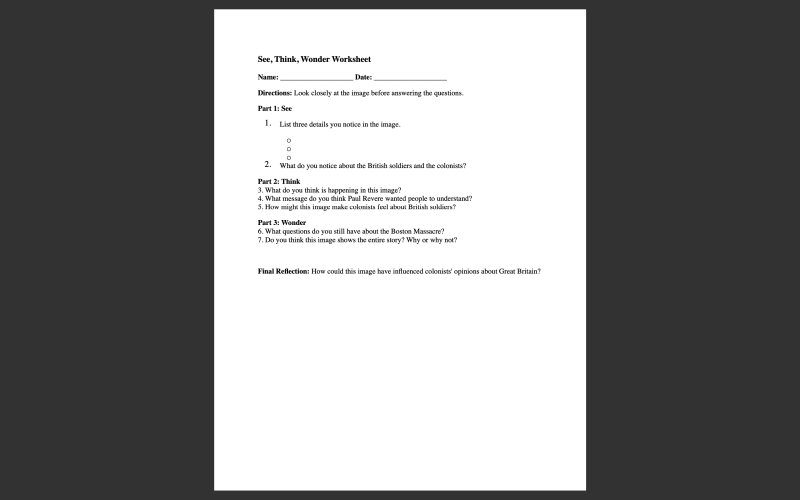
Students will complete a source-analysis worksheet by separating their observations from their interpretations. They will list what they can see, what they think it means, and what questions they still have.
4. Understand the Context — 10 minutes
The teacher will explain the relationship between Great Britain and the thirteen colonies, including British taxes, colonial protests, and disagreements about representation. Students will review a short timeline that includes the Stamp Act, Boston Massacre, Boston Tea Party, and Battles of Lexington and Concord.
The teacher will introduce key vocabulary and help students connect the historical events to the question of why the colonists wanted change.
5. Read Between the Lines — 15 minutes
Students will work in small groups to examine different historical sources. Each group will identify the creator, date, audience, purpose, and point of view of its source.
Sources may include:
- Paul Revere's engraving of the Boston Massacre.
- An excerpt from Thomas Paine's Common Sense (1776).
- The Declaration of Independence (1776).
Students will discuss what each source tells them and what information might be missing.
6. Exit Ticket — 5 minutes
Students will answer: “What was one cause of the American Revolution, and what evidence supports your answer?”
Day 2: Events and Effects of the American Revolution
7. Review — 5 minutes
The teacher will review the previous lesson using a timeline and ask students to name two causes of the Revolution.
8. Corroborate and Refute — 15 minutes
Students will compare at least three historical sources. They will identify information that agrees, information that differs, and questions that cannot be answered by the sources alone.
The teacher will encourage students to consider why different people might describe the same event differently. Students will also discuss how the experiences of Patriots, Loyalists, women, Black Americans, and Indigenous peoples differed.
9. Establish a Plausible Narrative — 15 minutes
In groups, students will create a timeline or cause-and-effect chart showing how disagreements with Britain led to conflict and independence. They will include at least four major events and explain how each event contributed to the Revolution or its outcome.
Students must use evidence from their sources to support their explanations.
10. Summarize Final Thoughts — 10 minutes
Students will independently answer the essential question in a short paragraph, a recorded oral response, or a visual explanation with captions. Their response must identify at least one cause, one major event, and two effects of the Revolution, supported by evidence.
11. Closing Discussion — 5 minutes
Students will share one thing they learned about the Revolution and one question they still have. The teacher will reinforce that historical events can affect different groups in different ways.
SOURCES / Worksheets
Source 1: Paul Revere's Boston Massacre Engraving
Teachers will project this image and students will fill out the worksheet below:


Source 2: Thomas Paine's Common Sense
Students read a short, teacher-selected excerpt from Common Sense and identify how Paine tried to persuade colonists to support independence.
https://www.gutenberg.org/ebooks/147

Source 3: Declaration of Independence Youtube Video
Project: Show a video to students and split them into groups to discuss, and then have each group share what they thought about the video.

Source 4
Explore the national parks related to the American Revolution:
https://www.nps.gov/subjects/americanrevolution/index.htm

